Try it in your pool for 30 days. Exchange it for another Dolphin for free, or return it with no restocking fee.
Your bag is empty.
By Steps, Ledges & Slopes
Robotic Pool Cleaners for Curved Walls: Freeform, Kidney, Round and Oval
A curve changes the angle at which a robot meets every wall and keeps steering it the same way, so cable management and navigation decide the result more than power does.
Our shortlist focuses on Dolphin models available with authorized-dealer support. The buying criteria below also give you a useful framework for evaluating alternatives from any brand.
Straight walls give a robot something simple to work with: it drives until it meets one, climbs square on, comes down and turns. Curved walls take that away, which is why the best robotic pool cleaner for curved walls is not chosen the way one for a rectangle is. In a freeform or kidney pool, a round or oval above-ground pool, or any pool with wide radius corners, the robot meets the wall at a slightly different angle each time and climbs a little on the skew. It is also nudged around the pool in one direction, turn after turn.
Neither troubles a tracked robot much, and every pick here lists oval and freeform among its published shapes. But one-way turning has a cost: it winds the cable. So the choice is largely a matter of how the robot manages its cable and keeps track of where it has been. We rank the Dolphin Quantum and three others on that basis. Above-ground rounds get separate advice.
$0 restockingNo-cost exchanges
Free shippingNationwide
Up to 3 yearsPremier & Sigma
30-day trialIn your own pool
Expert shortlist
Our Picks for Curved Walls, in Order
Ranked for this job, with the reason each model earned its place and the point where it stops being the right choice.
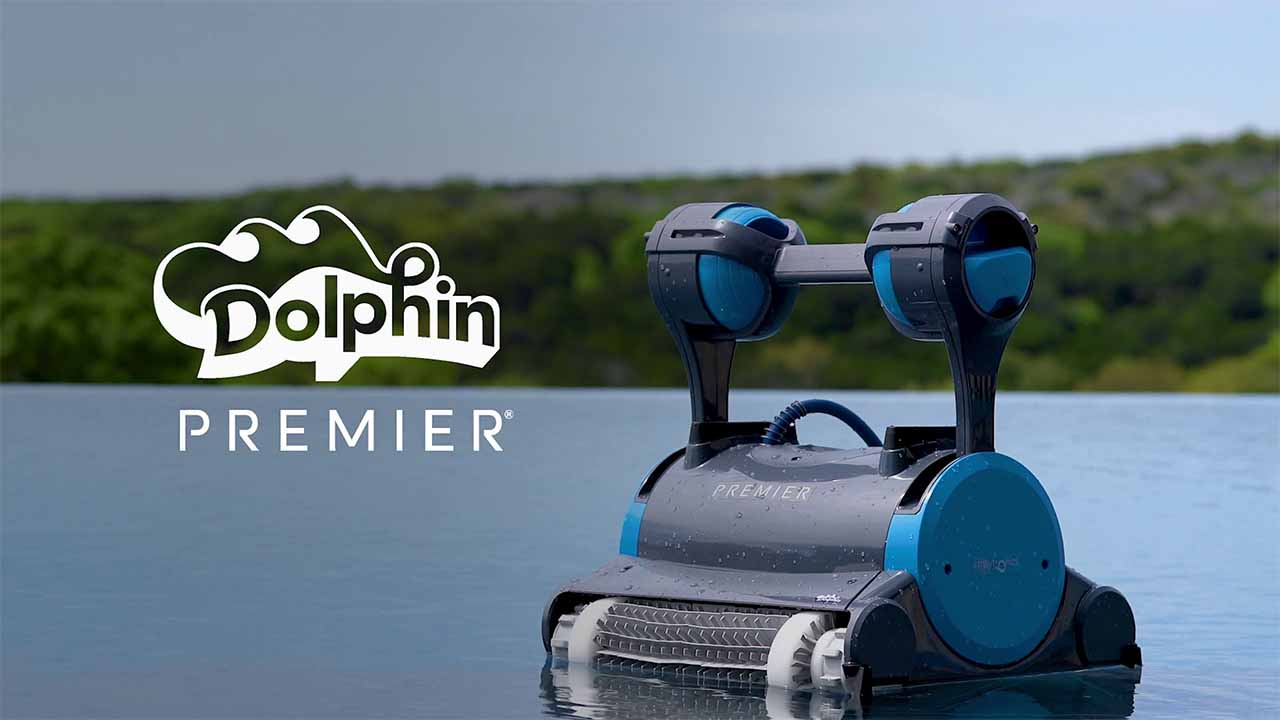
In a freeform or kidney pool the Premier's most useful part is the small one where the cable meets the robot. The 360-degree anti-tangle swivel lets twist spin out as fast as the curves put it in, so the 55 ft cable stays loose through the whole 3-hour cycle and the robot is free to follow the wall. Oval, freeform and L-shaped pools are all on its published shape list.
HyperGrip tracks hold a slanted climb, and dual scrubbing brushes follow the wall up to the waterline, where a curved tile line shows every missed stretch.
Best for
Freeform, kidney and oval in-ground pools up to 50 ft with a tiled or visible waterline.
Keep in mind
Scanning only. In a very irregular shape with coves and peninsulas, the Sigma keeps a more orderly path.
The Sigma's gyroscope gives it a sense of direction that does not depend on the walls being straight. SmartNav 3.0 uses it to hold a heading across open floor and to keep its bearings after a slanted climb, so coverage stays systematic in shapes that have no two walls alike. A 360-degree swivel on its 55 ft cable means one-way turning does not wind it up either.
Quad scrubbing brushes and three commercial-grade ProLine motors make it the strongest wall scrubber here. It is second because it costs the most, and in a simple oval or kidney the extra navigation changes little.
Best for
Complex freeform pools with coves, tight radius turns and several distinct areas.
Keep in mind
Top of the price range and 24.6 lb on the handle. In a plain oval or a gentle curve its advantage over our first pick narrows.
The Quantum gives you the feature a curved pool needs most, an anti-tangle swivel on a 55 ft cable, at the lowest price of the 50 ft robots here. Continuous rubber HyperGrip tracks grip a slanted climb, dual HyperBrush rollers spin at twice standard speed along the wall, and it cleans to the waterline.
Freeform pools often come with a sun shelf or curved steps, and the Quantum is the only pick whose published coverage includes those. Its cycle is 2 hours, so in a large freeform plan to run it more often.
Best for
Oval and freeform in-ground pools up to 50 ft, especially those with a shelf or curved steps.
Keep in mind
Shortest cycle among the 50 ft picks, and 2 years of warranty against 3 on the two robots above.
Round and oval above-ground pools are all curve, and the Cayman is the pick here that is published for above-ground use. It is rated to 33 ft, weighs 14.6 lb, and runs a 2-hour cycle on HyperGrip tracks, scrubbing with a HyperBrush that spins twice as fast as standard Dolphin brushes. Its 50 ft cable gives working room in larger rounds.
The cable has no swivel, and a round pool turns the robot one way all day, so lay the cable out straight before each run and untwist it weekly. It suits curved in-ground pools up to 33 ft as well.
Best for
Above-ground rounds and ovals, and curved in-ground pools 33 ft and under.
Keep in mind
No swivel, so the cable needs regular untwisting. Floor and walls only, and upper-wall climbing varies on soft walls.
How we ranked them: We matched filtration, brush system, coverage, debris capacity, automation, and warranty to this page's buying need. Pool fit carries more weight than the longest feature list.
Buying criteria
What a Curved Wall Changes for a Robot
01
The angle of the climb
On a curve the robot seldom meets the wall square. It climbs at a slant, and its tracks have to hold while one side leads. Good track grip makes this a non-event on firm walls. It shows mainly on slick surfaces.
02
One-way turning and cable twist
Following a curve, a robot tends to turn the same way again and again. Each turn adds twist to the cable in the same direction, so it builds faster than in a rectangle, where left and right turns partly cancel. A swivel releases it.
03
Navigation without straight lines
A robot that finds its way by scanning the pool has less to go on when no wall is straight. A longer cycle allows for that. A gyroscope gives the robot a fixed sense of direction that does not depend on the walls at all.
04
How firm the wall is
In-ground walls are rigid, and climbing them is predictable. Above-ground walls flex. A robot cleans the floor and the base of the wall well, and how high it climbs depends on how firmly the wall and liner resist its tracks.
Side-by-side
Cable, Navigation and Coverage Compared
Only the models recommended on this page, and only the specs that decide this choice.
In-Ground Curves: Freeform, Kidney and Radius Corners
Curves in an in-ground pool are rigid, so the climb itself is rarely the difficulty. What deserves a look is the tightest inside curve in the pool: the waist of a kidney, or a cove behind a peninsula. A robot is a rigid body of a certain length, and in a curve tighter than that body it touches the wall at its ends and leaves the middle to its brushes on a later pass. Wide, sweeping curves are cleaned as well as straight walls.
Check length too. The rating applies to the pool's longest straight run, not the distance around its curves.
Above-Ground Rounds and Ovals
An above-ground pool is the purest curved wall there is, and two things set it apart. The first is the cable. A robot circling a round pool turns one way all cycle, and neither above-ground robot here has a swivel, so the twist has nowhere to go. Lay the cable out straight on the grass before each run and untwist it fully every week. The second is the wall. A liner hung on a steel or resin wall gives under a robot's tracks more than concrete does, so expect a thorough clean of the floor and lower wall, with upper-wall climbing that varies by pool.
The Escape, which we also sell, suits this job and lists round among its published shapes. It is rated to 33 ft with a 40 ft cable, so once a round passes about 24 ft across, check that the cable will reach from the power supply's position before you commit to it. The Cayman's 50 ft cable is the safer choice when the run is long.
Running a Robot in a Curved Pool
Stand the power supply opposite the middle of the pool's longest side so the cable reaches every curve without stretching.
Look at the cable after each cycle. If it is starting to coil, the pool is adding twist faster than it is released; straighten it before the next run.
Brush tight coves and the waist of a kidney by hand now and then. Curves tighter than the robot's body are reached by brush ends only.
On above-ground pools, keep the water at its normal level. A full pool presses the liner against the wall and gives tracks a steadier surface.
Buy with confidence
Protection beyond the product.
Buying through an authorized dealer gives you a clear warranty and support path. When purchased here, every featured cleaner also includes free shipping, a 30-day in-pool trial, and $0 restocking on returns.
Yes. A robot does not need corners or straight walls to cover a pool. For round above-ground pools the Cayman is our pick here, and the Escape, which lists round among its published shapes, suits smaller rounds within reach of its 40 ft cable. Both need their cables straightened regularly.
Why does the cable tangle more in a curved pool?
The turns stop canceling out. In a rectangle a robot's left and right turns tend to balance. Following a curve it turns mostly one way, and every turn adds twist in the same direction until the cable coils. A swivel, fitted to the Premier, Sigma and Quantum, lets that twist spin out as it forms.
Will a robot climb the flexible wall of an above-ground pool?
It will climb, and how far depends on the wall. On a firm wall with a well-seated liner, the Cayman and Escape clean floor and walls. Where the wall or liner gives under the tracks, expect a good clean of the floor and the wall base and less consistent results higher up.
Is the best robotic pool cleaner for curved walls any different from one for a rectangular pool?
Not a different kind of robot, but the priorities shift. In a rectangle almost any tracked robot with the right length rating does well. In a kidney or freeform, a swivel cable matters more because of the one-way turning, and waterline cleaning is more visible along a curved tile line.
By Steps, Ledges & Slopes
Keep Exploring
Compare another buying need or open the complete guide library.
Ask two questions: is the wall rigid, and how complicated is the shape? Rigid and ordinary, such as a kidney, oval or gentle freeform: the Premier, for the swivel, the long cycle and the waterline, or the Quantum for the swivel at a lower price. Rigid and complex: the Sigma, for a path that does not rely on straight walls. Flexible, round or oval, and standing in the yard: the Cayman, provided you untwist its cable. Curves are easy for a robot. A twisted cable is what stops one.