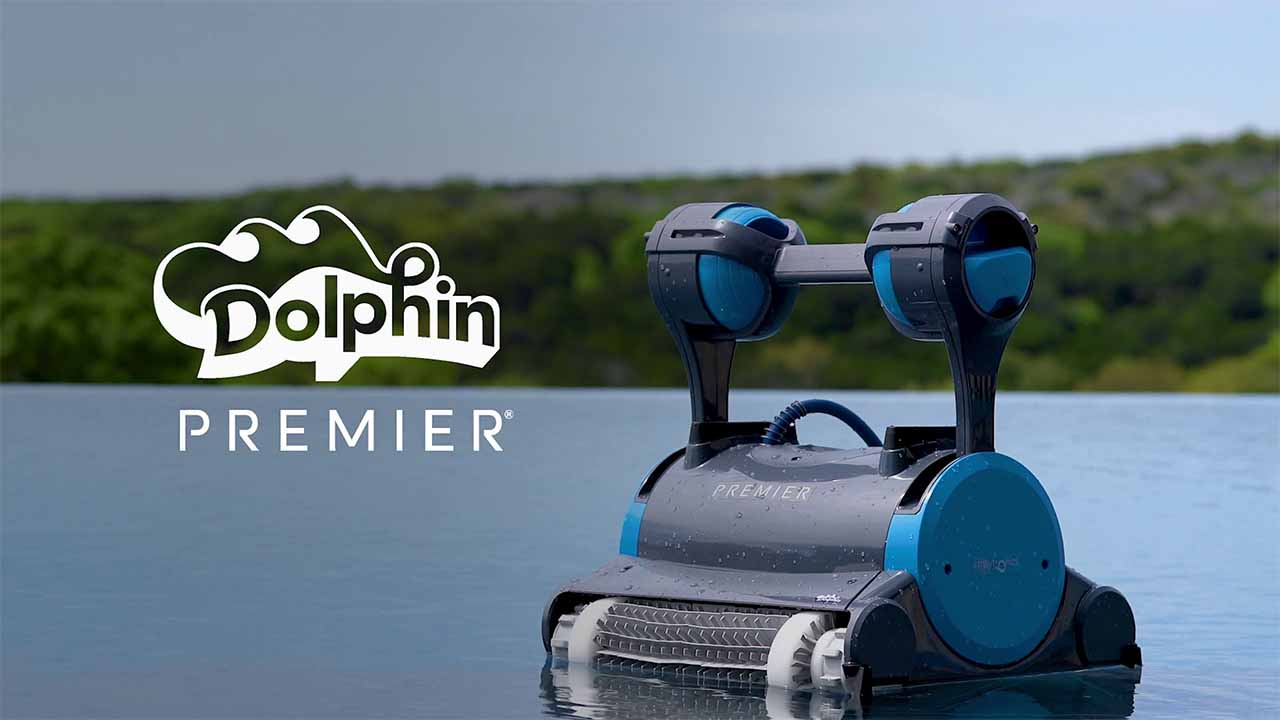
Our shortlist focuses on Dolphin models available with authorized-dealer support. The buying criteria below also give you a useful framework for evaluating alternatives from any brand.
Stand at the end of one leg of an L-shaped pool and you cannot see the far end of the other. Neither can the robot. The best robotic pool cleaner for L-shaped pools has to leave the leg it started in, round the inside corner, clean the second leg and come back, all while towing a cable past that same corner.
So two things decide this purchase before any feature does. The first is the path the robot and its cable must travel: both legs count there, even though the length rating is judged on the longer one. The second is where the power supply sits. Put it at the elbow and each leg becomes a short, direct run. Put it at one end and the cable has to bend around the inside corner on every trip.
$0 restockingNo-cost exchanges
Free shippingNationwide
Up to 3 yearsPremier & Sigma
30-day trialIn your own pool
Expert shortlist
Robots for L-Shaped Pools, Best Fit First
Ranked for this job, with the reason each model earned its place and the point where it stops being the right choice.
Fit starts with what a robot is published to do, and the Premier's shape list is the only one here that names L-shaped pools. The rest follows from the layout. A 50 ft rating covers the long leg of most backyard Ls. The 55 ft cable with a 360-degree swivel lets the robot turn into the second leg and back without winding up against the inside corner. The 3-hour cycle, longest of the four, leaves time for both legs.
It scrubs floor, walls and waterline, with NanoFilters and a leaf bag in the box.
Best for
True L and lazy L pools with a long leg of up to 50 ft, cleaned in one scheduled run.
Keep in mind
Scanning navigation and a timer on the power supply: no gyroscope and no phone control.
Each leg of an L is a rectangle, and the Sigma is at its best in rectangles. SmartNav 3.0 with an onboard gyroscope keeps it tracking parallel to the long walls and tells it which way it faces after rounding the inside corner, which helps it carry on into the second leg instead of doubling back. Quad scrubbing brushes and three commercial-grade ProLine motors do the cleaning, waterline included, over a 2.5-hour cycle.
It is second on price. The Sigma costs the most of any robot here, and an L is a simple enough layout that scanning covers it.
Best for
Large Ls whose owners want orderly passes and scheduling by day and time from a phone.
Keep in mind
Highest price of the four, 24.6 lb to lift, and its published shape list does not name L-shaped pools.
An L punishes a cable without a swivel, and the Quantum is the least expensive pick here that has one. It is rated to 50 ft, runs SmartNav 2.0 that senses ladders and drains, and covers floor, walls and waterline in a 2-hour run.
L-shaped pools often put the steps or a shallow play area in the short leg, and stairs, sun shelves and Baja ledges are all named in the Quantum's published coverage. Because the cycle is shorter, start it at the elbow so neither leg is shortchanged.
Best for
L-shaped pools over 33 ft on a budget, especially with steps or a shelf in the short leg.
Keep in mind
A 2-hour cycle has to cover two legs, and the warranty runs two years.
We set a stricter rule for the Cayman in an L than its rating alone requires. It is rated to 33 ft, but its cable, 50 ft long, lacks a swivel, and in an L the cable works against an inside corner on every pass. So we recommend it only when the two legs added together come to 33 ft or less: a compact L, or a small pool with a bench leg.
Inside that limit it is a capable floor-and-wall cleaner with HyperGrip tracks, a HyperBrush and a top-hatch MaxBin basket, and it is priced below all three 50 ft picks.
Best for
Compact L-shaped pools whose legs total 33 ft or less, with the power supply at the elbow.
Keep in mind
Straighten the cable by hand every few cycles or it will catch on the corner. The tile line is left to you.
How we ranked them: We matched filtration, brush system, coverage, debris capacity, automation, and warranty to this page's buying need. Pool fit carries more weight than the longest feature list.
Buying criteria
What Decides Robot Fit in an L-Shaped Pool
01
Both legs count
A robot's length rating refers to the longest straight run, which in an L is the long leg. But the robot and its cable also have to reach the far end of the short leg. Measure each leg along its outside wall and keep both numbers.
02
Power supply at the elbow
With the power supply on the deck outside the bend, the cable drops in at the junction and reaches either leg directly. From one end of the pool, the same cable must travel the full length of one leg and then turn the corner.
03
A swivel for the inside corner
The inside corner is the one hard edge in the pool, and a twisted cable shortens itself and drags across it. On the Premier, Sigma and Quantum an anti-tangle swivel lets those twists spin out of the 55 ft cable. The Cayman's 50 ft cable has none.
04
A published L-shape listing
Of the robots in this guide, only the Premier's published shape list names L-shaped pools alongside rectangle, oval and freeform. The Sigma and Quantum handle an L because they share the 50 ft rating and a swivel cable, but the listing belongs to the Premier.
Side-by-side
L-Shaped Pool Picks: Specs Side by Side
Only the models recommended on this page, and only the specs that decide this choice.
Take an L with a 30 ft leg and a 20 ft leg. Plug in at the end of the long leg and the cable must run 30 ft to the elbow, turn, and cover most of another 20 ft: close to 50 ft of water before you add the distance the power supply sits back from the edge. If your manual calls for roughly 12 ft, to use a typical example, the run passes 60 ft and no cable here reaches.
Now move the power supply to the elbow. The longest run is the 30 ft leg plus the same example setback: 42 ft, inside a 55 ft cable with slack to spare. Use the setback in your own manual, but the lesson holds for every L: the elbow is where the numbers work.
True L Versus Lazy L
A true L turns a square 90 degrees and has a sharp inside corner. A lazy L bends at a gentler angle, so the corner is blunt and the two legs partly face each other. For a robot the lazy L is the easier pool: more of the second leg is in view as it scans, and the cable slides around a blunt corner instead of catching on a sharp one. Size both the same way, leg by leg along the outside walls.
If One Leg Keeps Getting Missed
Uneven coverage in an L nearly always traces to the cable, not the navigation. Check these in order:
Is the power supply at the elbow? If it sits at one end, move it.
Is the cable coiled or kinked? A swivel clears twists; without one, stretch the cable out straight on the deck.
Is there too much cable in the water? Slack drifts into the inside corner and catches.
Does the robot always start in the same leg? Start it in the neglected leg for a few cycles.
Setup Tips for an L-Shaped Pool
Settle the power supply's spot on the deck outside the bend, at the setback your manual gives, before deciding anything else.
Lower the robot in at the elbow so its first passes can go either way.
Feed just enough cable to reach the far end of the long leg, and pull the rest back onto the deck.
After the first cycle, check the floor at the far end of each leg to see whether the setup is right.
Buy with confidence
Protection beyond the product.
Buying through an authorized dealer gives you a clear warranty and support path. When purchased here, every featured cleaner also includes free shipping, a 30-day in-pool trial, and $0 restocking on returns.
Do I add both legs together when sizing a robot for an L-shaped pool?
For the robot's rating, use the longest straight run, which is the long leg. For cable reach, add up what the cable must actually travel from the power supply to the far end of each leg. With the supply at the elbow those are two short runs. For the Cayman we apply a tighter rule and keep the combined legs within 33 ft.
Will a robot find its way into the short leg?
Yes. The short leg opens off the main pool at full width, so to a scanning robot it is simply more floor. Choosing the best robotic pool cleaner for L-shaped pools is less about finding that leg than about reaching its far end with the cable free, which comes down to where the power supply sits.
Can the cable get caught on the inside corner?
It can if it is twisted or if too much of it is in the water. A swivel, which the Premier, Sigma and Quantum have, lets twists spin out before they shorten the cable. Keeping spare cable on the deck keeps slack away from the corner.
What if there is no outlet near the elbow?
Pick the spot along the outside wall closest to the bend that your outlet allows, then redo the cable math from there. If the far end of either leg is out of reach, the lasting fix is an outdoor outlet nearer the elbow, installed by an electrician. Never move the power supply closer to the water than the manual allows.
By Pool Shape
Keep Exploring
Compare another buying need or open the complete guide library.
Measure both legs, then put the power supply at the elbow. The rating goes by the long leg: over 33 ft, buy a 50 ft robot. When the two legs together pass 33 ft we recommend one as well, for the swivel at the inside corner. The Premier comes first because it is the one that lists L-shaped pools. The Sigma adds gyroscope-straight passes, and the Quantum costs least of the three. Keep the Cayman for a compact L. Every order ships free by FedEx in 1-3 days, so the slow part is the measuring.