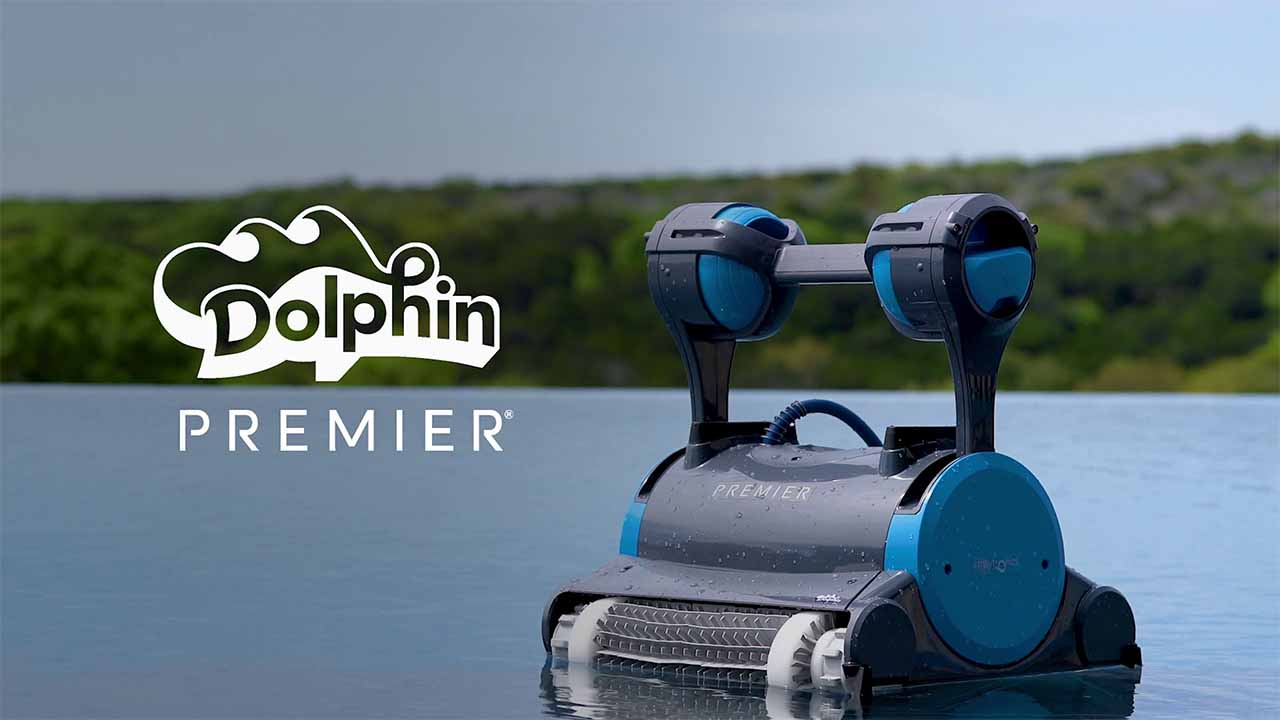
Our shortlist focuses on Dolphin models available with authorized-dealer support. The buying criteria below also give you a useful framework for evaluating alternatives from any brand.
Before you buy
No robot on this page is designed for a lazy river. On a small backyard river with the current switched off, a 50 ft robot can clean the channel one section at a time if you move the power supply. Resort and community rivers need commercial equipment.
People search for the best robotic pool cleaner for lazy rivers expecting a model name. The honest answer starts somewhere else. A lazy river is a long, narrow loop with a current, often hundreds of feet around, and a home pool robot is designed for a single basin up to 50 ft long with still water. No robot on this page was built for the job.
That does not make a robot useless in every river. A small backyard lazy river, the kind that circles an island or a patio, can be cleaned by a 50 ft robot if you accept three conditions: the current is off, the channel is wide and deep enough for the robot to turn around, and you clean the loop in sections by moving the power supply.
$0 restockingNo-cost exchanges
Free shippingNationwide
Up to 3 yearsPremier & Sigma
30-day trialIn your own pool
Expert shortlist
The Three Closest Fits for a Backyard Lazy River
Ranked for this job, with the reason each model earned its place and the point where it stops being the right choice.
If we had to clean a small backyard river with one of these robots, this is the one we would carry out to it. The reason is what lazy rivers collect. They wind through landscaping, the moving water gathers leaves and drops them when the pump shuts off, and the Premier's Multi-Media filtration includes an oversized leaf bag as well as NanoFilters and standard fine filters.
Its 55 ft cable rotates on a 360-degree swivel, the essential feature in a channel around an island, and the 3-hour cycle gives the robot time to work a full section, walls and waterline included.
Best for
Small backyard rivers with planting alongside, wide enough to turn in, cleaned one section per run.
Keep in mind
Not designed for rivers. At 20.3 lb it has to be lifted out and carried to each new section.
A river channel curves the whole way around, so the walls turn a robot constantly. The Sigma's gyroscope-guided SmartNav 3.0 is the navigation best suited to that: it knows its heading after each deflection and keeps working along the section. Quad scrubbing brushes handle floor, walls and waterline, and its cable has the same full-rotation swivel.
It sits behind the Premier for two practical reasons. It has no leaf bag, and at 24.6 lb it is the hardest of the three to lift and carry from section to section, which is most of what river cleaning involves.
Best for
Clean, lightly planted rivers where even coverage of a curving channel matters more than leaf capacity.
Keep in mind
Not designed for rivers. Highest-priced of the three, and weekly scheduling is of little use when the robot moves every run.
Cleaning a river in sections means lifting the robot out, moving the power supply and lowering the robot back in, several times over. At 18.3 lb the Quantum is the lightest of the three picks, and its 2-hour cycle is the shortest, so a three-section river takes six hours of running instead of nine.
It has the anti-tangle swivel a river requires on its 55 ft cable. Its published coverage also names sun shelves and stairs, and backyard rivers often open onto a shallow entry. It is the lowest-priced of the three, which matters when the job is outside the robot's design.
Best for
Owners who will move the robot several times per clean and want the lightest, quickest pick.
Keep in mind
Not designed for rivers. There is no leaf bag, and the warranty runs two years.
How we ranked them: We matched filtration, brush system, coverage, debris capacity, automation, and warranty to this page's buying need. Pool fit carries more weight than the longest feature list.
Buying criteria
The Conditions That Make a Lazy River Cleanable
01
The current is off
A robot holds itself to the floor with suction and steers by its own drive. A river current pushes it off line, tugs the cable downstream and stirs debris back into the water. Shut off the river pump or jets and let the water go still before the robot goes in.
02
Room to turn around
A robot does not only travel along the channel; it has to turn. Channels narrower than about 5 ft are marginal for any robot here, and very shallow channels will not hold suction. Check the working depth in the manual against the shallowest stretch of your river.
03
A cable is shorter than a loop
A 55 ft cable reaches only part of a loop, and the power supply has to sit back from the edge as well. So the river is cleaned as a series of sections, each within reach of one power-supply position. More loop means more positions.
04
A swivel, because of the island
The island in the middle of a river is something for the cable to wrap around, and constant turning in a narrow channel twists it. All three picks have an anti-tangle swivel. We would not attempt a river with a robot that lacks one.
Side-by-side
Closest-Fit Robots Compared
Only the models recommended on this page, and only the specs that decide this choice.
The method is simple, if not quick. Divide the loop into stretches that one power-supply position can serve, then clean one stretch per cycle. With a 55 ft cable and an example setback of roughly 12 ft, plan on sections of about 40 ft, which also keeps each one inside the robot's 50 ft rating. Use the setback in your own manual. A 120 ft loop comes to three sections.
Switch off the river pump and wait for the water to go still.
Set the power supply on the outer bank at the middle of the section.
Lower the robot in and feed out only enough cable to reach both ends of that section. Keep the cable on the outer side so it cannot circle the island.
Run the cycle, lift the robot out, empty the filter, and move everything to the next section.
Overlap sections by a few feet so nothing between them is missed.
Why the Loop Itself Is the Problem
A robot's rating describes one basin with ends: it travels out, meets a wall and turns back. A river has no ends. Left alone, a robot may keep going in one direction until the cable stops it, and a cable pulled around the island wraps instead of following. That is why the sections matter, and why the cable stays on the outer bank.
It is also why a schedule is little help here. A timer assumes the robot waits in the same water for its next run, and in a river it is in a different section each time.
Resort, Community and Water-Park Rivers
Everything above applies to a backyard river. A resort or community lazy river is a different animal: hundreds of feet of channel, a current that runs all day, heavy use and a maintenance schedule to keep. Those rivers are cleaned with commercial equipment sized for the length, and a residential robot moved from section to section is not a serious plan for them. If you manage one, call us with the channel length, width and depth, and we will say plainly whether a robot has any sensible part in your routine.
Practical Tips Before You Try It
Measure the channel at its narrowest and shallowest points first. If the robot cannot turn there, it will stall there every time.
Walk the loop and mark power-supply positions with outlet access on the outer bank before buying. Some rivers have none on the far side.
Net floating leaves before each section so the filter is spent on what has sunk.
Buy with confidence
Protection beyond the product.
Buying through an authorized dealer gives you a clear warranty and support path. When purchased here, every featured cleaner also includes free shipping, a 30-day in-pool trial, and $0 restocking on returns.
Can I run a robotic cleaner with the lazy river current on?
No. The current pushes the robot off its path, drags the cable downstream and keeps debris moving instead of settled. Switch the river pump off and let the water go still first. The best robotic pool cleaner for lazy rivers on this list is no exception.
How many sections will my lazy river take?
Divide the channel's length by about 40 ft as a starting estimate, then adjust for bends and for where you can place the power supply. Each section is one full cycle of two to three hours, so plan the whole clean across a day or spread it over several.
Will the cable wrap around the island?
It will if the robot is allowed to travel around the island while tethered to one spot. Keep the power supply on the outer bank, feed out only the cable each section needs, and never try to do the full loop from one position. A swivel handles twists; it cannot undo a wrap.
Is the Cayman or Escape an option for a small river?
We would not use either. Both lack a swivel, which a channel around an island needs, and both are rated to 33 ft. The Escape's 40 ft cable is the shortest of the five robots in this guide, which leaves too little reach to work a section.
My lazy river opens into the main pool. Will the robot wander in?
It may enter the river mouth if the opening is wide and deep enough, then turn back or carry on until the cable stops it. With the current off that does no harm. Limit the cable in the water, and clean the pool and the river as separate jobs.
By Pool Shape
Keep Exploring
Compare another buying need or open the complete guide library.
If the river is a backyard loop, wide enough to turn in, and you are willing to switch off the current and move the power supply section by section, a 50 ft robot with a swivel can clean it: the Premier for leaves, the Quantum for the lightest lift, the Sigma for heading control. If any of those conditions fails, or the river is a commercial feature, do not buy a robot from this list for it. Talk to us first.